
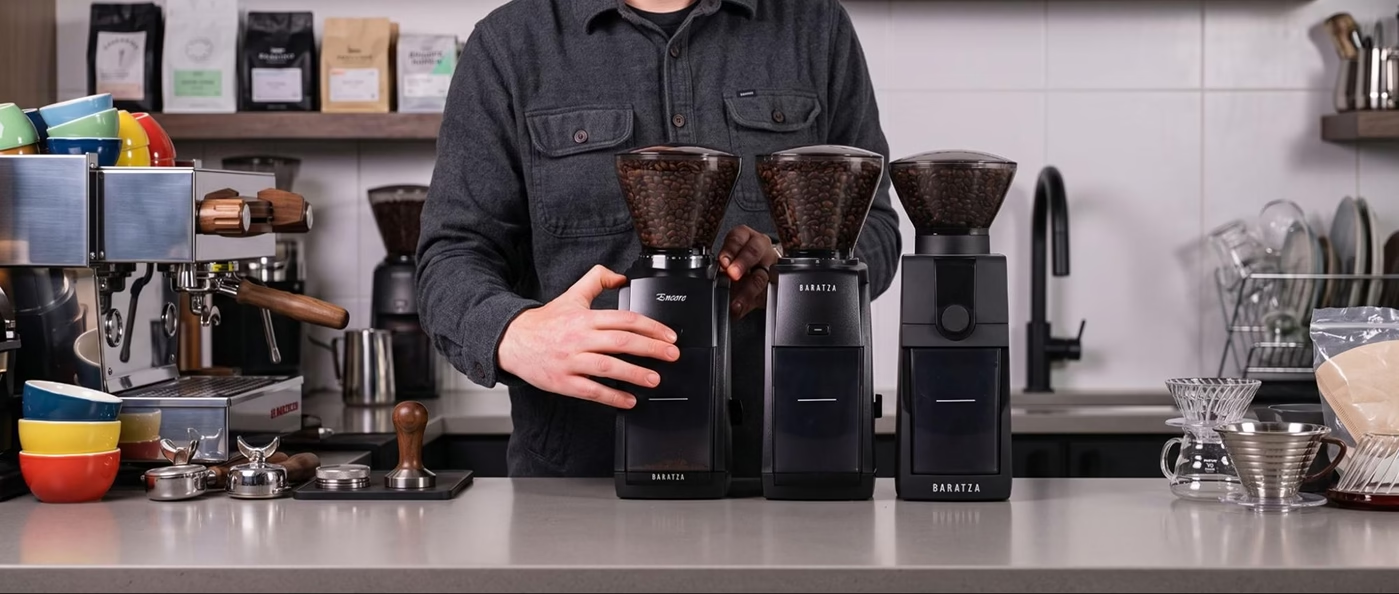
What a Home Coffee Grinder Costs in Pakistan
Home coffee grinders in Pakistan come at very different price points, but the right one for you depends less on your budget and more on how much time you’re willing to spend on your coffee each morning. Past a certain point, more money doesn’t make your coffee taste better, it just makes the process faster and more convenient.
Here’s what you’re actually paying for at each price level, and where spending more stops making a real difference.
What You’re Actually Paying For
Almost all the difference between an entry-level grinder and an expensive one comes down to the burrs. The mechanism itself is simple: two shaped grinding surfaces with a gap between them, and that gap has to hold steady while beans force their way through it.
What doesn’t affect quality (convenience only):
- A motor saves you the effort of turning the handle
- A digital display saves you counting doses
- A larger hopper means refilling less often
None of these change what ends up in your brewer. A motor grinds faster, not better, which is why a well-built manual grinder can hold its own against electrics costing considerably more.
What does affect quality, and it comes down to the burr itself rather than the rest of the machine:
- Ceramic burrs can chip when placed under strain
- Basic steel burrs lose their edge sooner than better-made ones, though how soon depends entirely on how much you grind and what you’re grinding
- A poorly supported shaft allows the grind size to shift on its own, even without any change to the setting
- Burrs that don’t sit perfectly square to each other grind unevenly no matter how good the steel is
Getting these fundamentals right is what actually separates a good grinder from a poor one, and it’s a large part of why prices vary so much between models. Better burrs cost more to manufacture, harder steel, tighter tolerances, precise bearing support, but they hold their edge for years instead of months.
One thing worth knowing before you compare tiers: burr design and how squarely the burrs are aligned matter more than which tier a grinder sits in. That’s why a good manual grinder competes with a mid-priced electric, and also why am inexpensive electric doesn’t automatically beat a good manual.
Entry Tier: A Manual Grinder
The Timemore Chestnut C3S is a manual grinder, so you turn a handle instead of pressing a button. It uses hardened steel burrs, has a sturdy all-metal build, and lets you fine-tune the grind size instead of locking you into fixed settings. A steady internal shaft also keeps the grind consistent every time you use it, something basic hand grinders often struggle with.
Who it’s ideal for:
- You mainly brew filter coffee (pour-over, French press)
- You’re happy to spend about forty seconds grinding by hand each morning
- You want reliable, consistent results without paying for a motor
Who it’s not ideal for:
- You want espresso, grinding fine enough by hand takes real effort and time
- You’re brewing for a full household at once, the small chamber only holds enough for one or two cups
- You want a fully hands-off, push-button experience
Mid Tier: Moving to Electric
The Timemore Sculptor 078S is an electric grinder built to handle both espresso and filter coffee well. Its 78mm burrs are cut for both fine and coarse grinding, so one machine covers a weekday espresso shot and a Sunday pour-over instead of needing two separate grinders. It also lets you change the grinding speed, which changes the texture of the grind rather than only how fine it is, and a built-in feature shakes loose grounds out of the spout so leftover coffee doesn’t mix into your next dose.
Who it’s ideal for:
- You brew both espresso and filter coffee, and want one grinder that does both well
- You want speed and consistency every morning without any manual effort
- You care about fine-tuning your grind for different brewing styles
Who it’s not ideal for:
- You only ever brew filter coffee, the manual grinder already covers this well for less
- You’re on a tight budget, this tier costs more, and pricing is available on request
Premium Tier: Grind-by-Weight
The Baratza Sette 270Wi, priced at ₨185,500, weighs the grounds as they fall and stops exactly at the gram you asked for, dosing straight into the portafilter using Acaia’s weighing technology.
Who it’s ideal for:
- You pull several espresso shots daily and want precise, repeatable dosing without manually weighing each one
- You value having grind-by-weight built directly into the grinder rather than using a separate scale
- Consistency and speed in your routine matter more to you than the upfront cost
Who it’s not ideal for:
- You’re happy weighing doses with a separate kitchen scale, which achieves a similar result
- You brew occasionally rather than multiple times a day, where the convenience matters less
- You’d rather put the budget toward coffee itself instead of grinder precision
So What Should You Spend?
There’s no universal “best” here, it depends entirely on how you actually drink your coffee.
If you’re brewing filter coffee only, the entry tier is genuinely enough, and it’s worth stopping there. A well-built manual grinder can match a mid-priced electric in cup quality, provided the burr design and alignment are comparable. The motor changes speed, not the ceiling on grind quality, burr quality does that. What you’re trading is around forty seconds of your morning, which might feel like nothing or a lot, depending on your mornings.
Pulling espresso, or brewing both espresso and filter from the same beans, changes the calculation. The mid tier tends to make more sense here, since it’s the first point where a single machine handles both ends of the grind range properly, instead of doing one well and the other only approximately.
For anyone making multiple espresso shots a day, where consistency and speed matter more than upfront cost, the premium tier earns its place.
Whichever tier fits how you brew, it’s worth spending on the grinder before the brewer. A good grinder paired with a basic dripper will consistently beat the reverse, since no brewer can fix an uneven grind after the fact. If the brewer is the part you haven’t settled yet, how to choose a coffee brewer works through that, and how to make good coffee at home covers what to do once both are on your counter.
Kitting out a café rather than a kitchen? The commercial grinders are a different comparison entirely.
Try Before You Decide
Grinding is a hands-on experience, and no spec sheet can tell you whether forty seconds of turning feels effortless or tedious to you personally. The only real way to know is to try it yourself.
Bring your own beans to the roastery on Bedian Road and grind the same coffee on a manual grinder and an electric one, side by side. Feel the difference in effort, listen to the difference in sound, and see how the grind size compares. Then decide with your hands, not a comparison table.
Ready to find your grinder?
Drop by the roastery and we’ll walk you through every tier in person, or reach out to us and tell us how you brew. You can also browse the full grinder range on your own. We’ll help you land on the grinder that actually fits your mornings, not just your budget.
Frequently Asked Questions
Is a manual grinder as good as an electric one?
For filter coffee, often yes. The motor only changes speed and convenience, not grind quality, so a well-built manual grinder can match electrics costing considerably more. What decides the cup is burr design and how squarely the burrs are aligned, which is why some electrics beat it and some don’t.
How much should you spend on your first coffee grinder?
Enough to get steel burrs, stable bearings, and stepless adjustment. That’s the point where cup quality stops improving quickly with price, and most of what you pay beyond it is convenience rather than better coffee.
How long does it take to grind coffee by hand?
About forty seconds for a single 15g pour-over dose. Espresso fineness takes noticeably longer by hand, which is why manual grinders work best for filter coffee specifically.
Do ceramic or steel burrs last longer?
Steel does, by a wide margin. Ceramic resists corrosion but chips easily under regular use, while hardened steel holds its edge for years of daily grinding.
Should you buy the grinder or the brewer first?
The grinder, always. It has a far bigger impact on how your coffee actually tastes, since no brewer, however good, can fix a grind that’s inconsistent.


Leave A Comment